How To Double Pinstripe a Surfboard
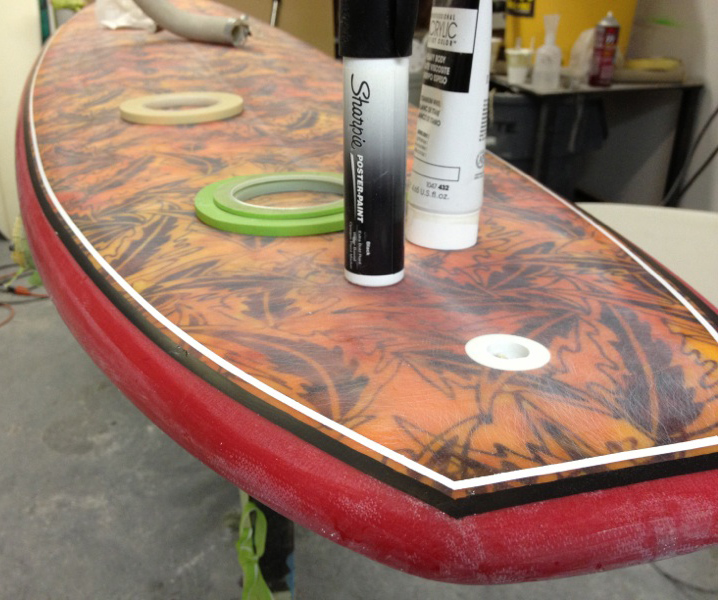
Pinstriping really makes a surfboard graphic or paint job pop. Even a white board with a double pinstripe looks elegant. In this article, I’ll show how to do a double pinstripe from scratch on a sanded board before the gloss coat. The surfboard I am showing in this tutorial has a colored laminate base that we are going to pinstripe over to cover the edge and clean up the look between the laminate and the deck graphic. To really make the look pop, the second pinline will be white an 1/8" inside of the outer black pinline.
First I made sure the area that is going have the pinstripe was sanded to 220-320 grit. It is very important to make sure that the sanding scratches from rougher grits are thoroughly removed in the area where you are going to put the double pinstripe. If they are not, the paint will run under the tape through those scratches and need to be scraped off with a razor blade.
After making sure the area receiving the pinstripes was sanded to the right grit, I then removed the sanding dust from the area to be pinstriped. A microfiber cloth, surgical blue tac rag, or a clean white cotton rag with acetone work well for this. It is a good idea to wipe down the whole surfboard, as dust will tend to travel. After you have wiped the dust down and have a clean area to pinstripe on, pick the widest tape you think will accept the curves you need to make. A wider tape is often easier to make fair curves with, however on longboards, it can be difficult to get the tape to take the curves at the nose.
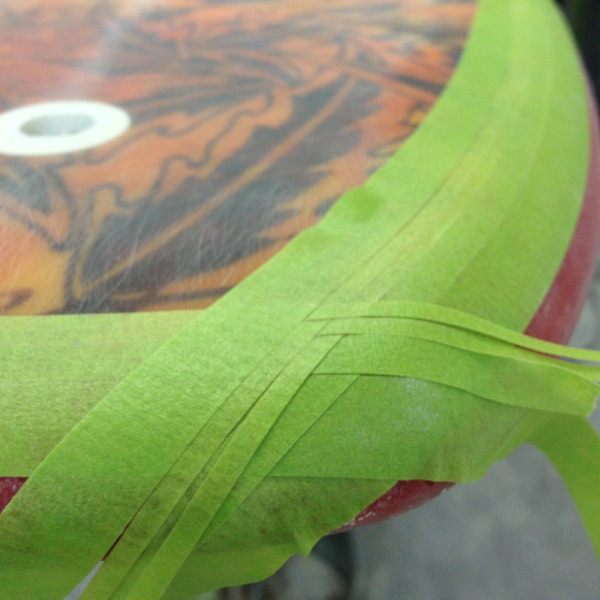
Using half inch 3M 233+ tape, I tape off about 1/8" to the outside of the cut lap line. This outer pinstripe in black will be 1/4" wide and cover the lap line to hide its unevenness and give it a cleaner edge. As I go, I sight down the curve of the board to make sure I am fair and don't have any crazy wobbles.
The next step is to gloss the board and really make it look good. If needed, I'll pull up the tape and re-do until it is fair. Often on a cut lap, the cut isn't even and you'll just have to do your best to
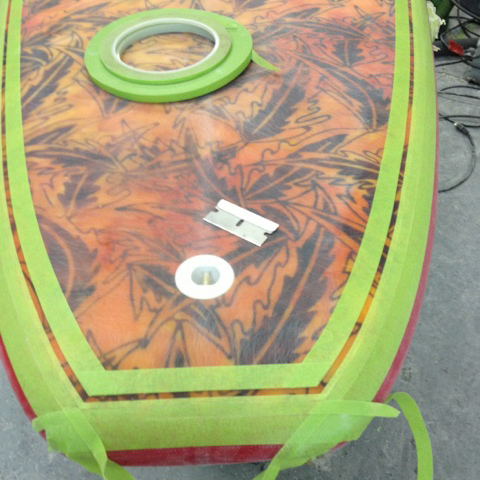
get the pinstripe true enough to cover over irregularities. After I laid down the first band of tape, I put down a filler tape where the pinstripe is to be. For my double pinstripe, I am going to make a 1/4" pinstripe with 1/8" space between stripes, and a 1/8" pinstripe, so the next band is going to be my 1/4" 3M 233+ tape that will become the area where I have my 1/4" pinstripe. The 1/4" tape gets placed down so that the edge of it butts up against the 1/2" tape. It is important that it is tight to that edge, not over it or away from it. Next, I laid down a band of 1/8" tape again butting that up right against the 1/4", follow that up with another band of 1/8" tape, this will be the band that becomes the white pinline on this surfboard. Finally lay down a band of 1/2" tape butting that up against the last layer of 1/8" tape. You should now have 5 bands of tape, starting from the rail going inward: 1/2", 1/4", 1/8", 1/8", and 1/2".
After laying down all 5 bands of tape I cleaned up the overlaps with a razor blade, taking care to remember which bands would be pulled.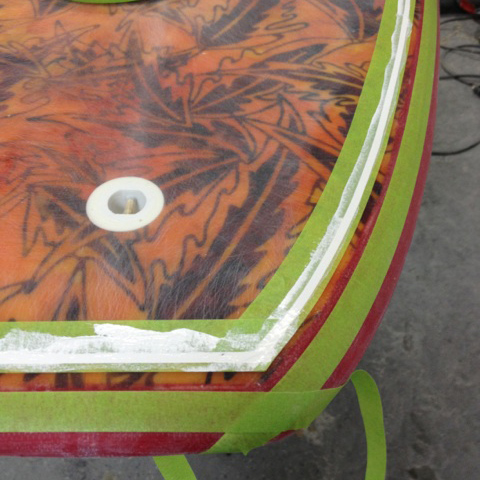
On this surfboard, I did the white pinstripe first, and in order to prevent paint from getting into the black pinline area, I left the 1/4" tape in place while putting down the white pinline. I pulled the 1/8" tape out of the area where the 1/8" white pinline is to go. I then burnished the tape edges to get a good seal and to push the tape adhesive into the sanding scratches.
Once properly burnished, I used acrylic paint and just ran the opening of the tube over the pinline area, squeezing very gently. In any areas that were too thick, I came back with the razor blade and used it as a squeegee to level the pinline down to the thickness of the tape.
Next I pulled the tape out of the 1/4" pinstripe, and for that, I used a water-based Sharpie brand Poster Paint Pen to color in the pin line. I like to let it dry and do a second coat. As soon as the two coats of black were completed, I pulled the tape. I wanted to make sure and pull the tape on the white pinline before it had time to dry, so I would get a nice clean edge. The black marker goes on so thin that it doesn't matter if you pull the tape after it dries, but the white is thick, and if you wait until it is dry, you may not get a clean edge and may have some lifting problems.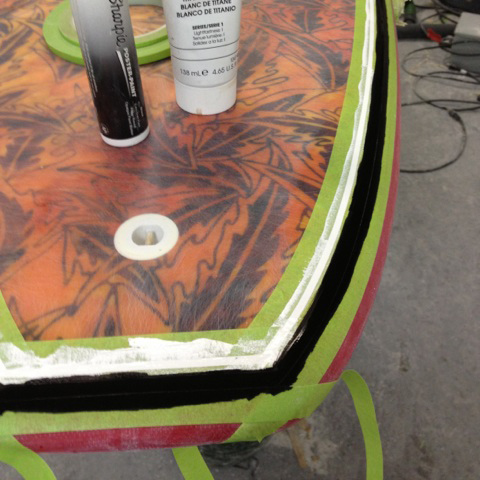
There were a few areas where the paint did run down a sanding scratch and under the tape, but this is no big deal. I'll just let everything dry up completely and scratch the runs off with the edge of a razor blade.